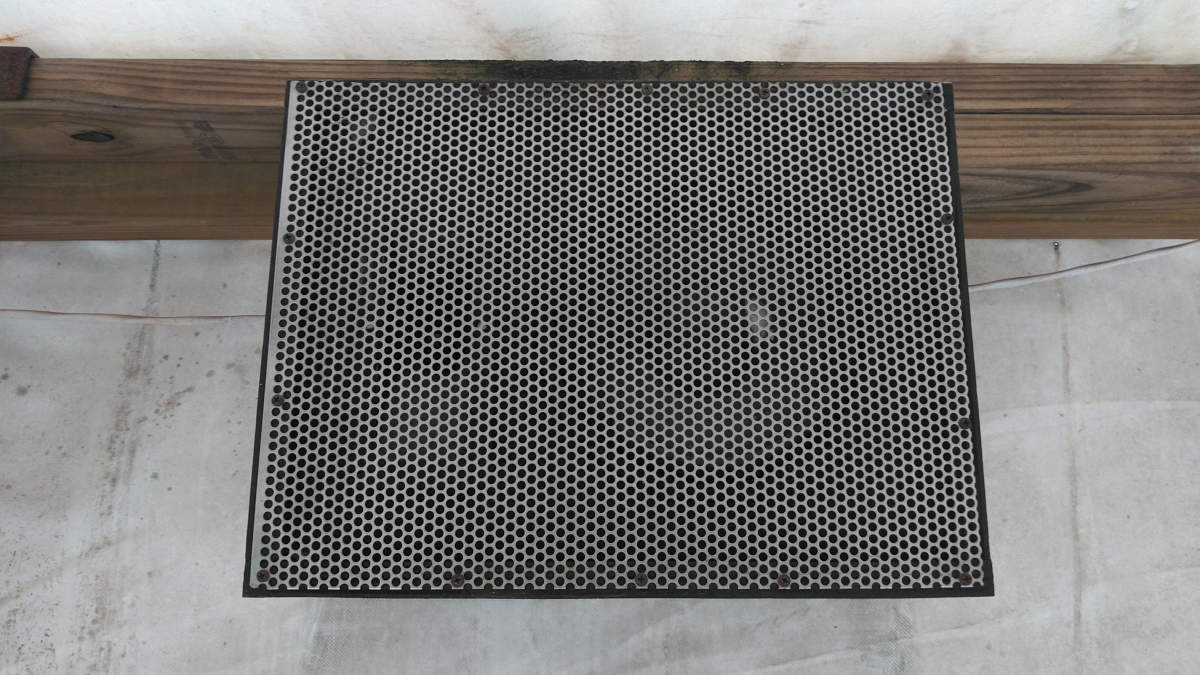
This post isn’t exactly about RDing or even announcing. I don’t want to move into “how to build a track”, in part because I can’t say I’ve got that much experience and in part because I don’t find it that interesting! However, one aspect of a track is really important to your ability to RD effectively: the sound system.
The sound system is important from both perspectives. As the RD, it’s important that you are able to speak to those present wherever they are likely to be at the race facility. From the perspective of attendees, the audio at the track will sound good or not. It will be too loud, too quiet, or comfortable to be around. The sound system has a major impact on how pleasant it is to be at the track.
I have some basic qualifications in this area. I played in party and bar bands for about a decade in my youth. During that period, I built and managed several different PA systems ranging from simple practice systems to one capable of about a 1,000 person venue. I’ve owned two different track facilities of my own and as an RD I’ve seen MANY different track sound setups.
I’m going to run through my current track’s sound system, because it combines several different approaches from which you can pick and choose to meet your needs. My choices favor the cheap and reliable… I’ve bought a lot of used gear. You can obviously spend more on similar, new(er?) equivalents. But we have to start with a few basics about sound equipment.
There are three audio “domains” or types of equipment. Home audio is home stereo equipment like Pioneer, Denon, Bose (Bose does also make pro audio), etc. You will not want to use a home audio receiver, but we’ll talk about home audio bookshelf speakers. Office public address equipment is used in commercial settings like department stores. This domain has mixer/amps similar to what we want, but uses a different standard on the output side (signal going to the speakers, office PA uses 70V or 100V) and typically includes “priority muting” that turns down other inputs when someone uses the microphone. We don’t want that. Pro audio is equipment designed for stage musicians. It is tough and heavy and has all the features we need. If you have a permanent install, this is the stuff you’ll want… on the electronics side at least. It’s also readily available used and lasts pretty much forever.
There are two important ratings and basic rules you will (mostly) follow. Watts describes the amount of power a piece of gear can output or handle as an input. The group of speakers connected to a single amp channel (an amplifier can have multiple channels that operate independently) should be rated to handle more watts than the amplifier channel is rated to output. Mostly. Those speakers MUST present to the amplifier a resistance in ohms that is not lower than the lowest ohm rating the amplifier channel can handle… typically 4 ohms, sometimes 2 ohms. There are special rules for combining speakers and running them from the same amplifier channel. Multiple speakers together can handle more watts than the individual speakers’ ratings. Wiring speakers together changes the ohms they present to the amplifier, and can increase or reduce that rating, see: Speaker Ohms Calculator As a general rule, wire your speaker sets to rate 4 to 8 ohms and all will be well.
Here’s a rundown of the components we’ll have, their function, and the signal levels being used. This is an important paragraph:
At the track, the RD uses a microphone that outputs a mic level signal that needs to be pre-amplified immediately. The scoring computer (and any other music source you might use) outputs a line level signal that is ready to be used by audio components. These inputs go into a mixer that pre-amps the microphones, combines the inputs, allows you to adjust one versus the other, and outputs one signal at line level. This goes to one or more amplifiers that boosts the signal to speaker level output, routed to speakers that make noise. If you have an FM transmitter, the line level mixer output will go to that as well. It is common to see mixer and amplifier combined into a single unit, whether for office PA or pro audio use, but these don’t need to come together.
Conceptual Design
Fancy term for “where to put speakers” and “how to power them”. Your basic options are few large speakers with lots of power covering a large area or many little speakers with less power each covering a smaller area. With any speaker, it is louder up close or directly in front of it and less loud as you move away or to the side. The sound also changes, since high frequencies travel farther than bass frequencies… the sound has less bass as you move away and therefore sounds less good.
My objective is to provide the best sound where people spend the most time. Where people spend little time, I’m OK with less ideal sound. As a result, I cover the pitting space with lots of little speakers, and the track areas with a few bigger ones.
These things lead us to the concept of “zones”. A zone is a physical area covered with sound from one amplifier channel and the speaker or speakers it drives. In most basic form, each place where people do something different should be a different zone. Driving. Pitting. Marshaling. By making these different zones, you can control the volume and sound quality in each different area. I want great sound in the pits (where people spend most of their time at the track), good sound on the driver’s stand (where they spend the time that brings them to the track), effective sound across the track (where people spend little time and already don’t want to be), and great sound where people watch the racing.
My current track has the following zones, and the number/type of speakers that cover them:
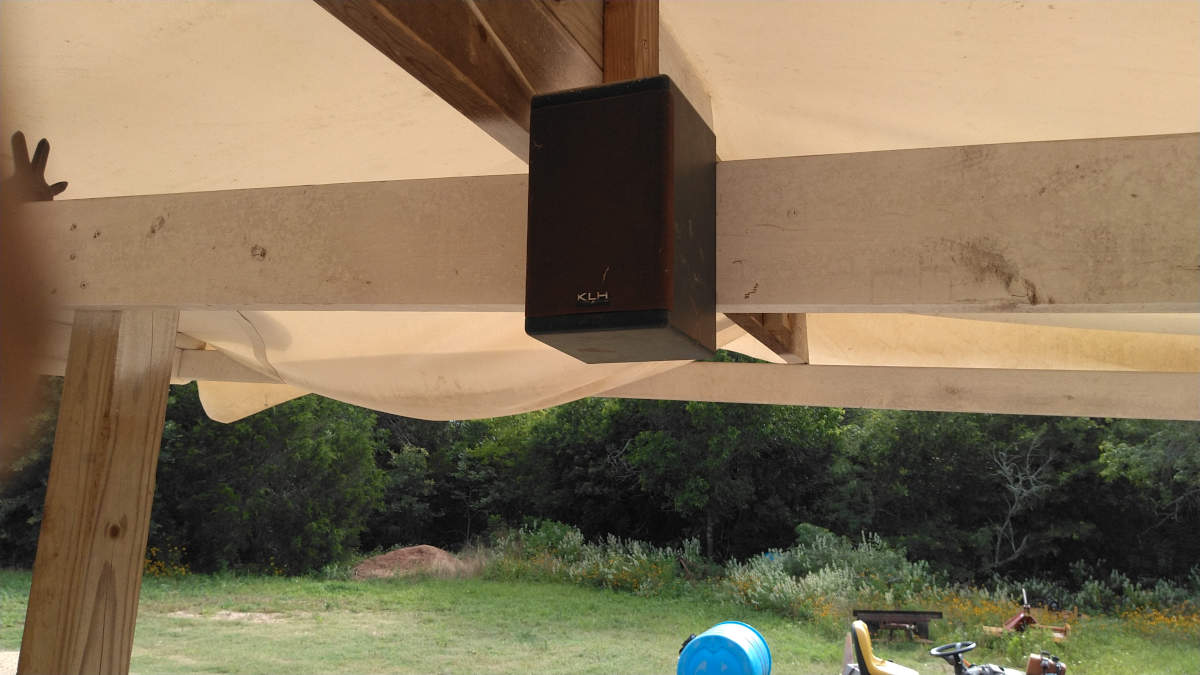
A – On road driver’s stand. Three good waterproof speakers.
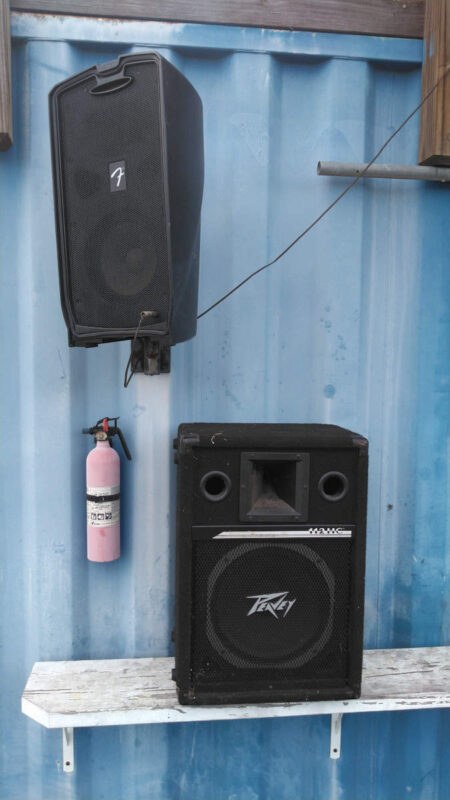
B – On road track area. Two large pro audio speakers, these are put out just for race days.
C – Oval driver’s stand. Two good waterproof speakers.
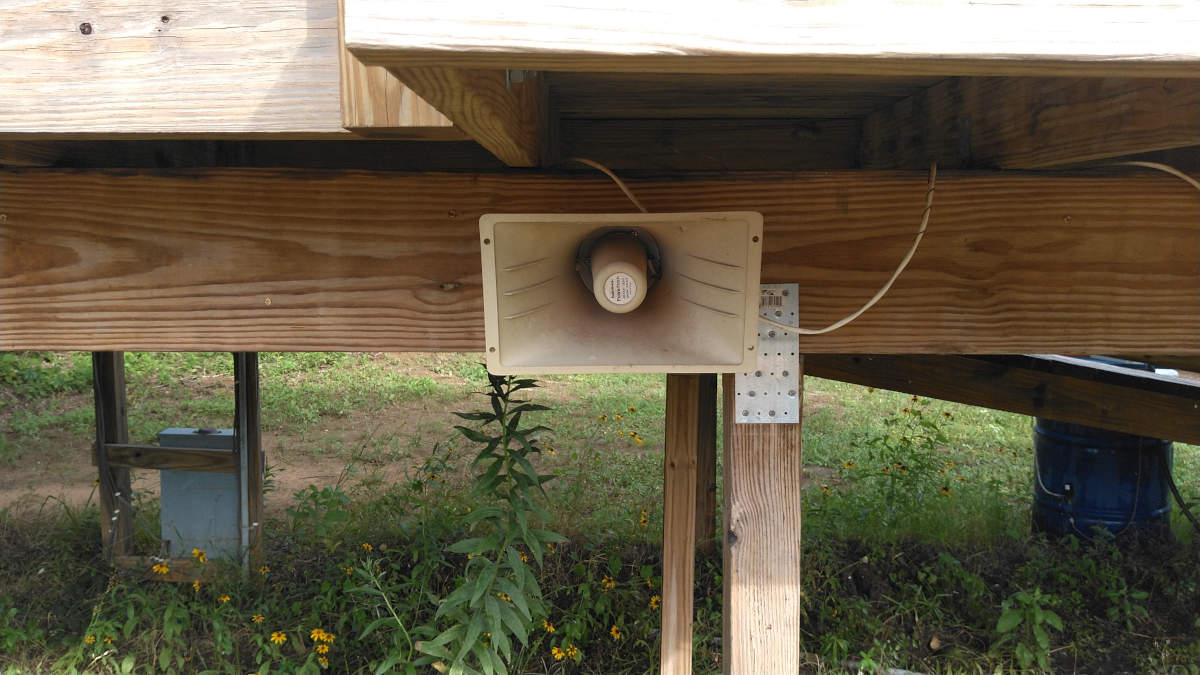
D – Oval track area. Three outdoor powerhorns.
E – Director’s Booth. Each booth has nice little Bose speakers so the RD can hear race audio.
F/G/H – Pitting area. Six bookshelf speakers, which are actually in three zones only because they’re not identical.
You probably don’t want this many zones, but we’ll talk about how to do this at a reasonable cost. One question you might have: why powerhorns on the oval and pro audio speakers on the on road? The only neighbor close to the track is right across the road, and the on road speakers have to point right at them. Powerhorns are focused and heavy on the higher frequencies… and therefore travel a long way. Using pro audio speakers keeps the clear audio on the track from being very loud across the road. They’re also much more pleasant to stand next to, as when pitting nitro on road. This sort of choice is one of the advantages of using zones to control your sound.
My Equipment
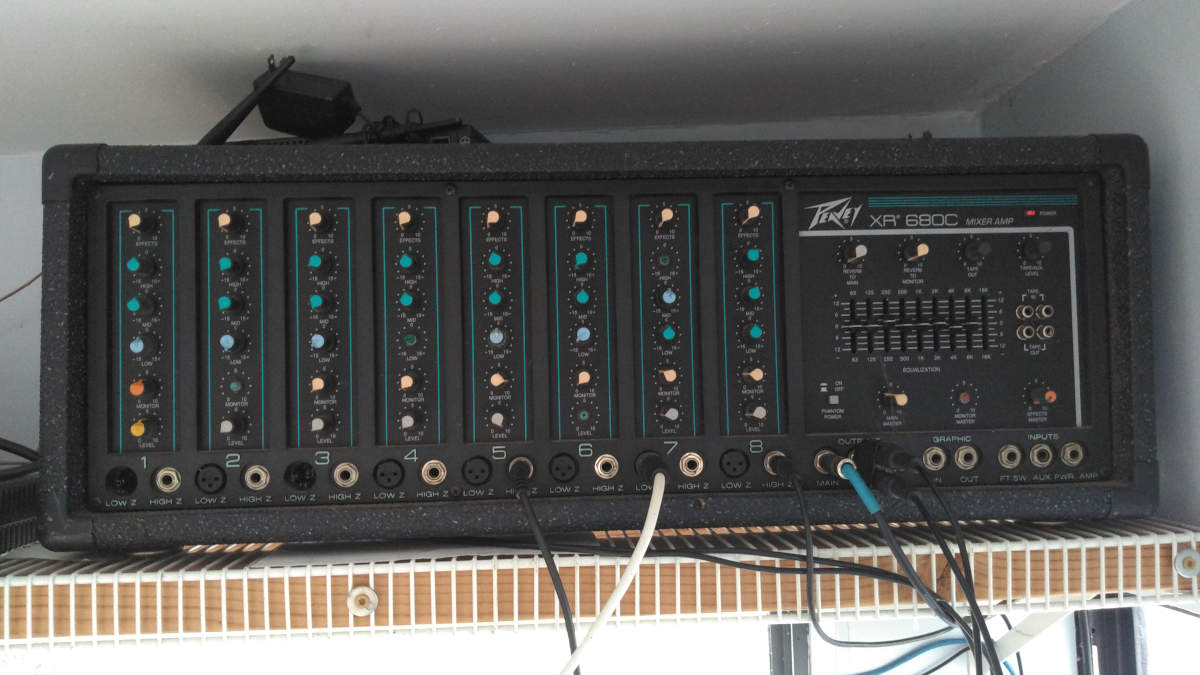
I will recommend pro audio gear as your main equipment, from brands like Peavey, Crate, Yamaha, Carvin, QSC. To a lesser degree, Rockville and Pyle, which are cheaper knock offs. Even quite old units can be reliable if they test well, although they’ll be large and heavy. You get a lot for your money on Facebook Marketplace or Craigslist. For me, Peavey equipment is ideal. It’s mid-range PA gear that’s build for hard use and seems to last forever. Here’s my Peavey XR680C mixer/amp (also commonly called a PA head), which I bought for $100:
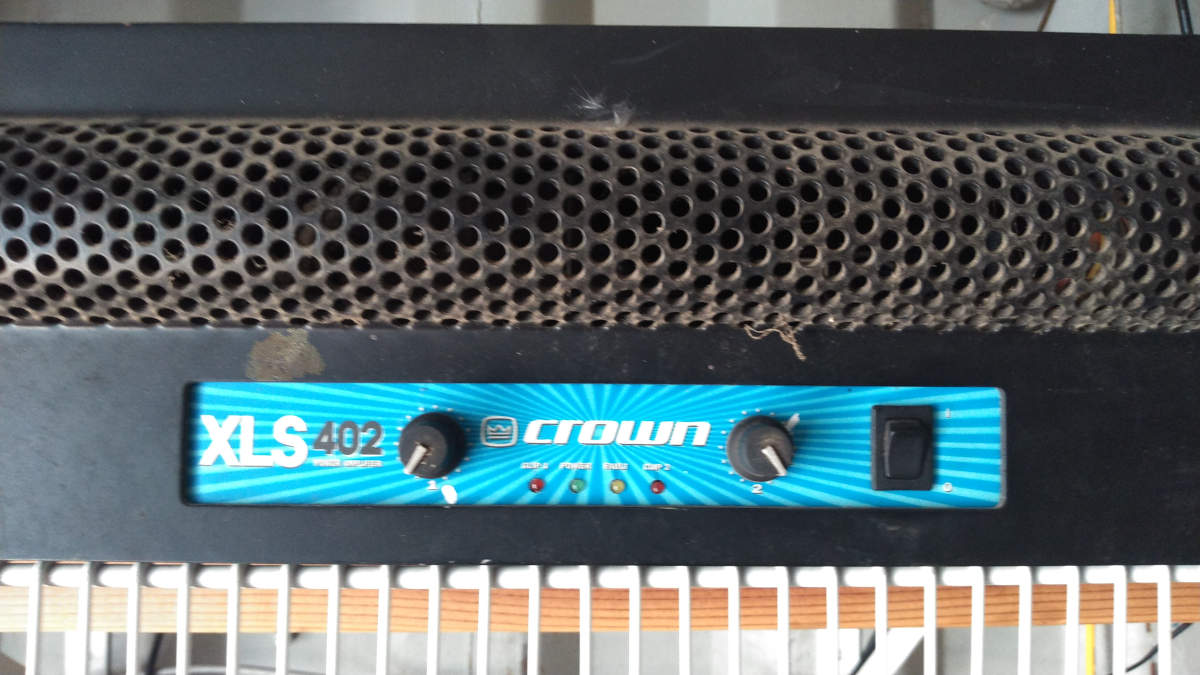
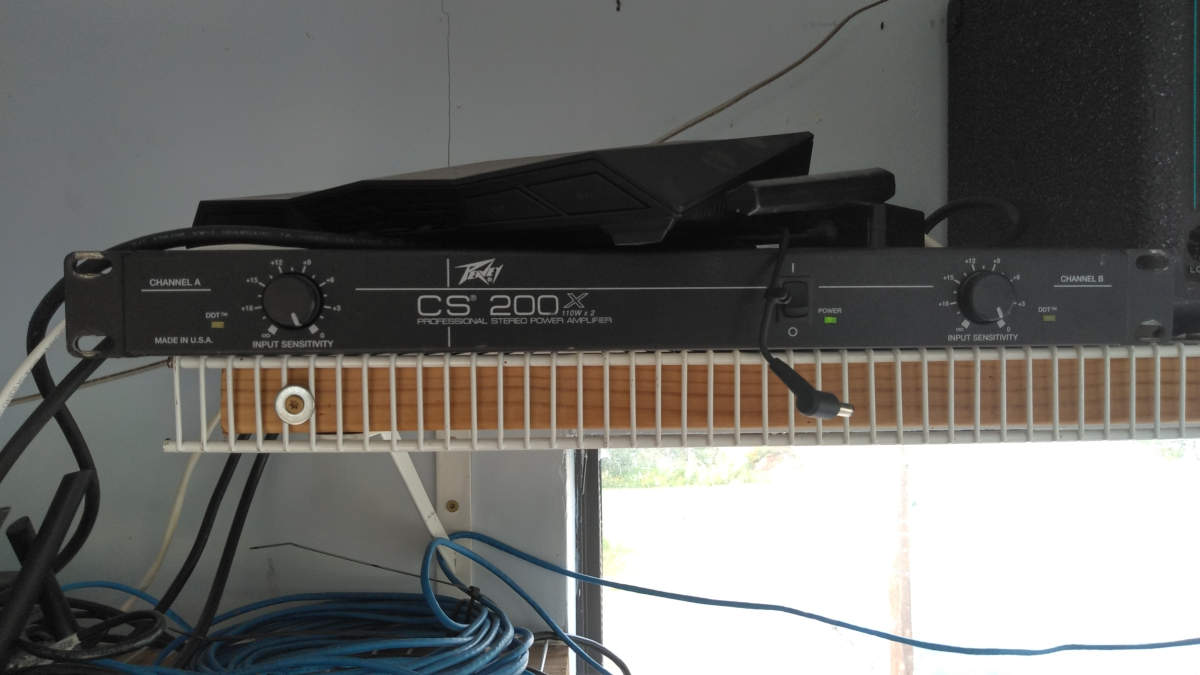
It’s from sometime in the 1980s. The mixer has FAR more inputs than I will use (you’ll also note in this picture that some of them are jacked up… missing knobs, busted input jacks). At my track, this unit is left on 24/7/365 in a d-booth that exceeds 100 degrees all summer and I’ve had it for years. The single amplifier inside puts out a couple hundred watts and powers the on road driver’s stand speakers. There are two line outputs that drive external amplifiers, and these are split and daisy chained into three amplifier channels and one FM transmitter. My external amps are also used pro audio gear. There’s a Crown 402XLR (400W x 2, $100) and a Peavey CS200 (110W x 2, $100). Note that you should watch the input and output connectors… I bought the Crown super cheap knowing I’d want to install different jacks.
I’m only using one side of the Crown amp most of the time, and it drivers the on road track speakers. This seems like a good place for a warning. Some amps, like this one, have a fan that runs any time the amp is turned on. This amp’s fan is so loud that it lives in the connex below my booth. Something to check.
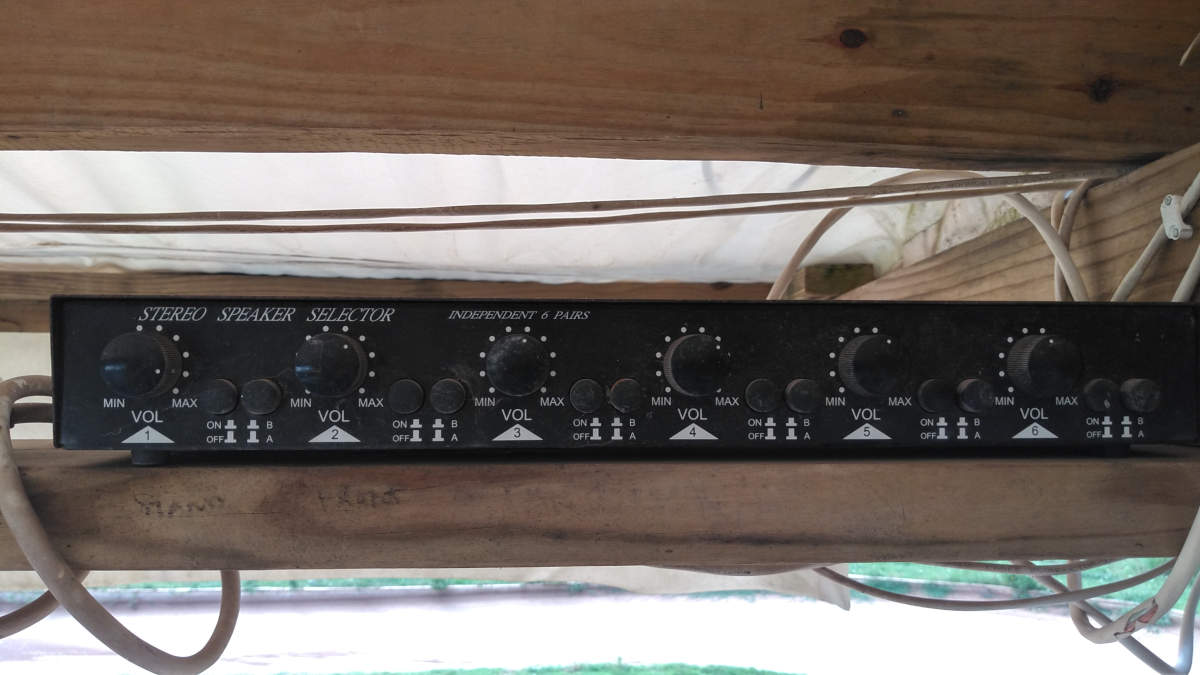
The CS200 does most of the actual work for me, and magically makes 12 different zones using a pair of speaker selectors. These little boxes accept speaker level input of up to 100 watts, which makes this amp a good choice to drive them. The selectors do ohm balancing so the amp sees a simple 8 ohm load, and provide SIX outputs each with a volume control. Mine have no brand, but searching right now I find the Pyle PSLSW6 at Amazon… functionally equivalent at about $100-120.
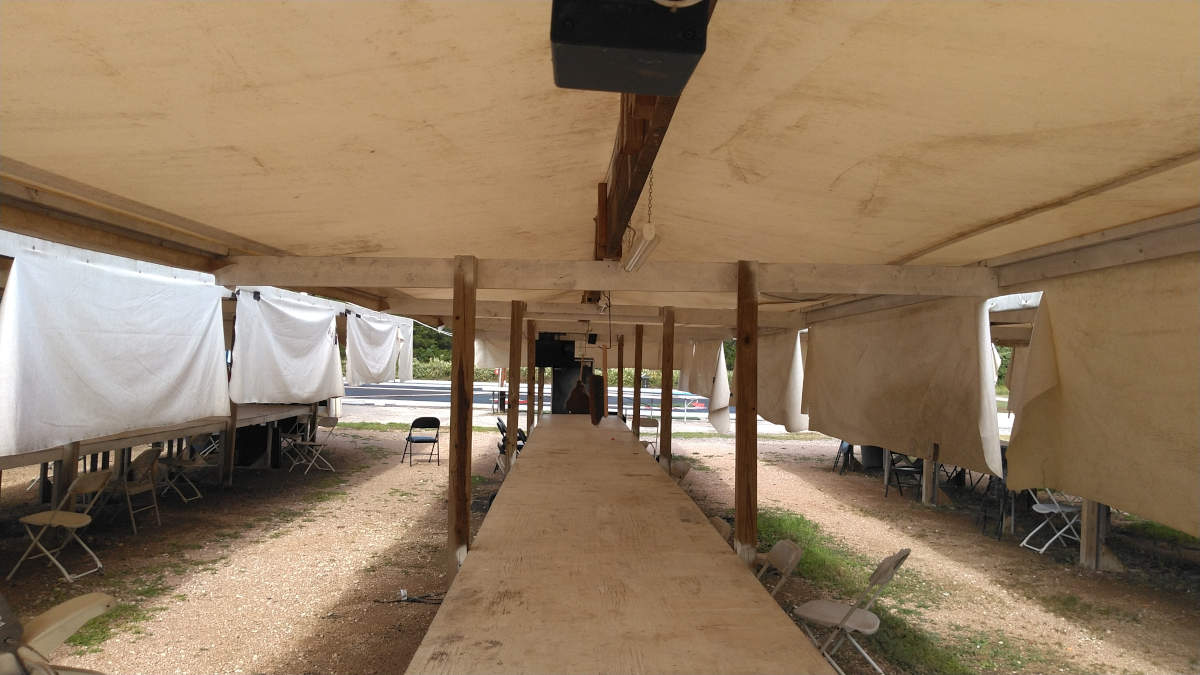
Speaker selector one lives in the pits. Each pit table is 48’ long and seats 16 people, and gets one output channel running two bookshelf speakers. Speaker selector two is on the oval stand. Each of the following get a channel: driver’s stand, track, d-booth, “booster” speaker just for nitro late models. Obviously, I have room to expand on both six output units.
The last zone I have is the on road d-booth, and it’s got a neat approach. The track computer lives in here, and I’ve split the audio output with one side going to the PA head and the other driving a cheap “stereo mini amplifier” rated at 20 watts. This approach puts out just the track computer audio in the booth, so you don’t have to listen to your own amplified voice but can hear the music and scoring system.
As we’ve sort of already covered, I use four types of speakers.
1 – Powerhorn. This is a cheap, easy way to provide sound to a large area. Because it’s annoying and bad for music, use it where people only spend a brief amount of time and just need to hear vital information. These are a good way to cover track marshals. Mine are all old Radio Shack units, but RS is mostly out of business.
2 – Bookshelf speakers. Believe it or not, these cheap little home speakers are a great way to cover small areas with good audio. They’re small and easy to mount, don’t go very far, and can provide listenable music and speech. You can get outdoor versions, or deploy indoor versions in covered areas. I have three different brands, each in pairs… brand doesn’t matter much. A pair of bookshelf units rated as low as 50W each should survive 100W input when wired together.
I am totally amazed at how well these cheap little speakers work for me. I’m showing the 48′ pit row (there’s another speaker at the far end)… everyone seated in the row can hear race audio and announcing just fine, although I’d like to be able to create a bit more volume. I’ll probably go a little bigger, or add another pair in the middle.
3 – Pro audio PA speakers. Used in live music and public address applications, these speakers have a decent woofer and some sort of tweeter in a heavy, durable enclosure. Depending on configuration, they can be extremely capable and might require a lot of power. They’ll need to be in well-sheltered location or be brought inside between uses. I own Peavey and Fender brands, and use either depending on how much noise I need.
4 – Homebuilts. I am a skilled woodworker and have built many speakers, so of course I’ve built some track speakers. The five driver’s stand speakers all use water-resistant drivers: 6.5’ polypropylene cone woofers and piezo horns. They’re in simple plywood sealed enclosures (some of which are slowly falling apart!). They sit outside and are live all of the time.
Put Yours Together
Here’s the actionable information. Using the above, I think you can adapt my approach to any track configuration you may have. Expand this list as necessary. Prices may vary in your area, and of course nicer and newer stuff costs more.
PA Head. Start here, because its input jacks will determine the exact microphone you need. Buy a major brand used pro audio mixer/amplifier off Facebook Marketplace or eBay. Again, I love Peavey. $100-150. I suggest using this head to drive your main speakers, and running everything else from external amp(s) and/or speaker selector(s).
Microphone. You need at least one. I’ve started buying Amazon Basics vocal mics, cardioid XLR. Select it to connect to a mic input on your PA head… either xLR or ¼”. Make sure it has a switch. $25. Always have a spare microphone and cable on hand.
Amplifier. Look for an amp (with NO mixer) rated about 100-125 watts, mono or stereo to meet your needs. Keep the power in this range to drive a Speaker Selector without blowing it up. $100 or so. Note that a mono amp has a single channel, a stereo amp has two, and you can buy amps with up to 8 channels.
Speaker Selector. If you are designing a lot of zones, grab one or two of these to limit the number amps required. Pyle PSLSW6, $110.
Mains Speakers. If you can handle taking them in out of the weather, used pro audio main speakers. Again, I love the Peaveys. Units with 8” or 10” woofers (Peavey 110H or PVi10, Fender Passport, Rockville on Amazon) are smaller, lighter, and easier to move. 12” woofer PA speakers sound better and are louder. Use passive speakers, without a built-in amp. Price ranges substantially, and ones with small woofers are difficult to find used.
Wide Area Cover Speakers. Cover broad areas with powerhorns, but mount them in a way that people will not be right next to them, like on a pole or where no one stands. Nippon and Pyle on Amazon… you are unlikely to find these used. $30 each.
Up Close Speakers. Ideal for pitting. Examining options here, I recommend searching eBay for “outdoor bookshelf speakers” and limiting that to “new”. Dual, Rockville, and KLH are lower end brands at about $60 a pair. I’m sure they lie about power handling, but in my experience you won’t blow these matching a pair to one output channel of the Selector and driving that with a 100W amplifier. You can certainly spend more, and you can use indoor speakers if they’re covered (I do… but when I replace a pair I buy outdoor).
Cables and Wire. You will need some cables to connect things, but gather the things before making a cabling purchase. The PA head to other amplifiers will probably be ¼” mono shielded cable. The PC output is 3.5mm stereo, and it will need to connect to either a line in (often two RCA jacks) or a ¼” mono jack. Speaker outputs on amplifiers are probably ¼” mono, but they can be run using unshielded two-conductor wire. Some amplifiers have terminals for bare wire or more exotic pro audio connectors. Pro audio PA speakers can probably take a ¼” mono input. Bookshelf speakers and powerhorns will connect with two-conductor bare wire. Where you run two-conductor wire to speakers, use at least 16-gauge copper wire. If outside, definitely use outdoor rated wire, which has a sheathe that protects the insulation from sunlight. “Lamp cord” — the power wire used for table lamps and similar — will last about 1 year in full Texas sun, longer if you never bend or touch it.
Other Items
There are three other items worth discussing briefly.
If you need fully portable audio, because you are in a parking lot or similar, you might consider a self-contained “portable PA”, which is a speaker with mixer and amplifier built in. An example from Amazon is the LyxPro SPA-10. Such a device will need at least one mic input, one line input, level controls for each, and a master volume control. These are not useful otherwise, but are great if you need to show up somewhere and create a minimal amount of sound.
To provide audio to a very large area – a field full of trailers, for example – you can use an FM transmitter. These range from $100-200, and cover around 500-800 yards range cleanly on the higher power setting. You will provide a line out, usually to a 3.5mm jack on the device. If your booth is a metal building, use a cable to run the small antenna to the roof. You can find transmitters by searching Amazon for “church FM transmitter”. Obviously, racers will need an FM radio to receive audio.
You might think you want a wireless microphone. I’ve thought that at least twice and acted on it. Neither one was effective enough to continue to use. If you definitely want one, stick to mid-range and better units from major brands like Shure and Nady, and keep extra microphone batteries on hand. Expect $300-400 used for one that is worth owning.
That’s a wrap!
Well, that’s what I’ve got. I hope something in here is helpful to someone out there! I simultaneously feel as though I went on forever and left a ton of stuff unsaid…